
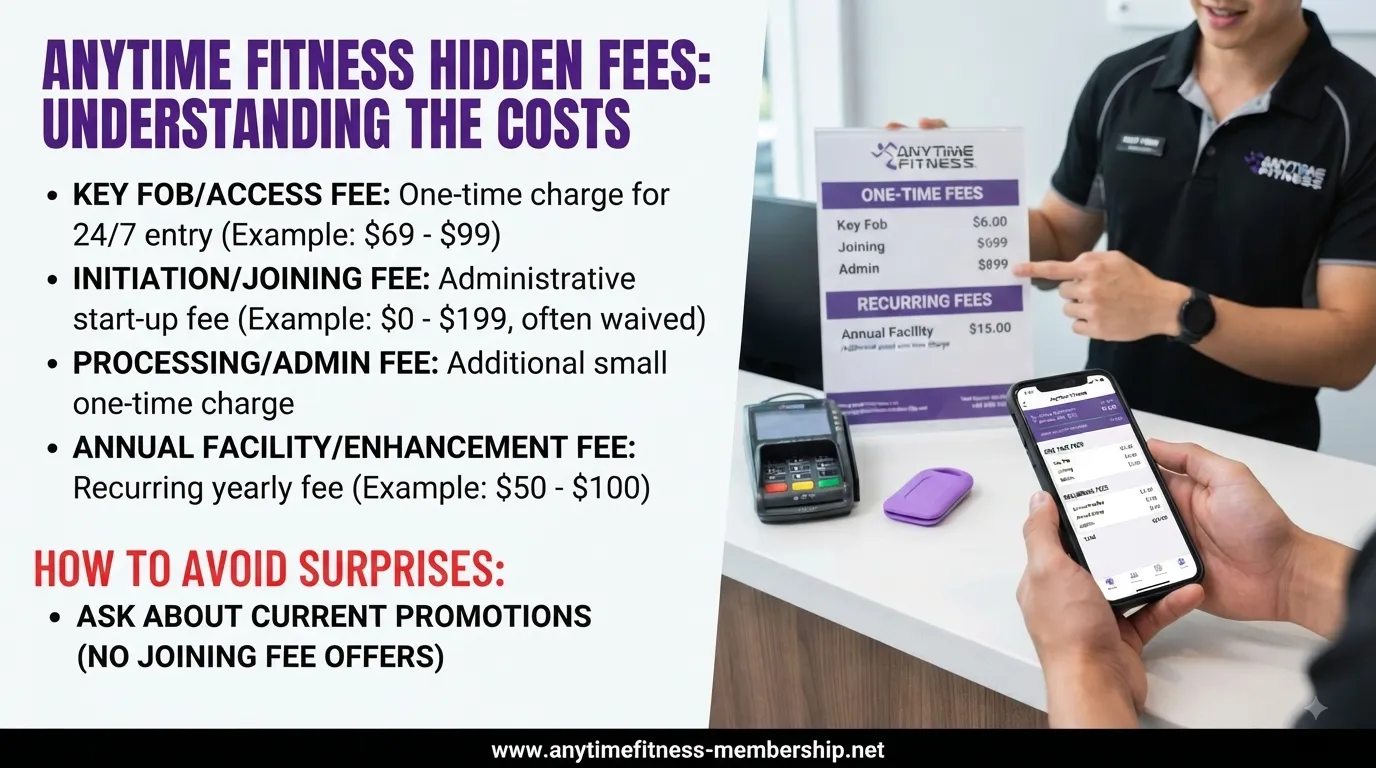
Anytime Fitness Hidden Fees: What You May Pay Beyond the Monthly Rate
The monthly membership price is usually the first thing people notice when joining a gym, but it may not represent the complete cost. Anytime Fitness hidden fees can include an initiation charge, key fob cost, cancellation or freeze fee, personal training, and other club-specific expenses.
One important thing to understand is that Anytime Fitness clubs are independently owned franchises. Because of this, fees and membership terms can differ from one location to another. Since Anytime Fitness clubs operate independently, always confirm the fee structure with your specific location.
Before signing a membership agreement, it is worth asking what you will pay on the first day, each month, and if you later cancel or pause your membership.
What Are Anytime Fitness Hidden Fees?
Anytime Fitness hidden fees are additional charges that may appear alongside the basic membership price. Some are one-time costs, while others may apply only when you use a particular service or change your membership.
Common examples include:
| Fee or charge | Typical amount | When it may apply |
|---|---|---|
| Initiation fee | $25–$100 | When starting a membership |
| Key fob/access card | $10–$25 | For gym access |
| Personal training | $30–$75 per session | When purchasing training |
| Cancellation or freeze fee | $25–$50 | When cancelling or pausing |
| Miscellaneous charges | $5–$20 | Depending on the club |
| Club-specific amenities | Varies | For selected services |
These figures are typical ranges described in the available information, not guaranteed prices for every Anytime Fitness location.
Why Can Anytime Fitness Fees Be Different?
The main reason is the franchise structure.
Many Anytime Fitness locations are independently owned and operated. That means a gym in one city may have different membership prices, initiation charges, promotions, or additional services than another location.
Your final cost can therefore depend on:
- Your local club
- Membership type
- Contract terms
- Current promotions
- Whether a key fob is included
- Optional services you purchase
- Cancellation or freeze policies
- Local fees and membership conditions
For this reason, checking the terms for your specific club is more useful than relying on a single nationwide price. You can find your nearest club using the Anytime Fitness location directory.
Do All Members Pay Hidden Fees?
No. Not necessarily.
Some fees may not apply to everyone. For example, personal training is an optional service, while an initiation fee may be waived during a promotion. A club may also include the access key fob in the membership rather than charging separately for it.
The important point is to ask about every possible charge before completing the membership.
Anytime Fitness Initiation Fee
The initiation fee is one of the most important upfront charges to check.
A typical range cited is $25–$100, and it is generally a one-time payment when you start your membership.
The charge may cover things such as:
- Account setup
- Administrative work
- Initial membership processing
- Gym orientation in some cases
However, the exact purpose and amount can depend on the location.
Can the Initiation Fee Be Waived?
Yes, a promotion may sometimes reduce or eliminate the initiation charge.
Promotional periods mentioned include:
- New Year
- Summer
- Back-to-school
Annual prepaid memberships may also have different upfront pricing and can potentially waive the initiation fee.
If you are ready to join, ask the club whether a no-joining-fee promotion is currently available before paying the standard initiation charge.
Anytime Fitness Key Fob Fee
A key fob or access card may be required for entry to the gym.
The typical cost described is $10–$25 as a one-time charge.
Because the key fob is connected to access, it is worth asking whether the price of the membership already includes it.
A simple question can prevent an unexpected charge:
“Is the key fob included in my membership, or is there a separate fee?”
The answer may vary between locations.
Cancellation and Freeze Fees
Another cost to understand before signing up is what happens when you want to cancel or temporarily pause your membership.
The available information gives a typical cancellation or freeze fee range of $25–$50.
A freeze may be useful if you want to temporarily stop using the gym rather than permanently ending your membership. However, the club’s specific rules determine whether a fee applies and what conditions must be met.
Before joining, ask:
- Is there a cancellation fee?
- Is there a freeze fee?
- How much does each cost?
- How much notice is required?
- Are there special conditions for cancelling or freezing?
Getting these answers in writing can make the membership easier to manage later.
Personal Training Costs
Personal training is different from a mandatory membership fee because it is an optional service.
The typical range provided is $30–$75 per session.
The actual price can depend on the club and the training package you choose.
If you only want gym access, make sure you understand whether personal training is included, optional, or separately billed.
Club-Specific Amenities and Miscellaneous Charges
Not every extra cost fits into a standard fee category.
Some locations may offer additional amenities or services, such as classes, nutrition counseling, or premium services. These can have their own prices.
Miscellaneous charges are described in the $5–$20 range, although the exact reason for such a charge can vary.
This is why asking for a complete fee breakdown is important.
A useful checklist is:
| Question to ask | Why it matters |
|---|---|
| What is the monthly membership price? | Shows the recurring base cost |
| Is there an initiation fee? | Identifies the upfront charge |
| Is the key fob included? | Prevents a $10–$25 surprise |
| Are there cancellation fees? | Helps you understand exit costs |
| Is there a freeze fee? | Shows the cost of pausing |
| Are personal training sessions extra? | Prevents confusion about optional services |
| Are there other club fees? | Helps reveal miscellaneous charges |
| Are promotions available? | May reduce your initial cost |
How Much Could the First Month Cost?
Looking only at the monthly membership price can make two memberships appear similar when their first-month costs are actually different.
Here are the example figures provided:
| Membership type | Base monthly fee | Additional fees | Example first-month total |
|---|---|---|---|
| Standard | $40 | $50 initiation + $15 key fob | $105 |
| Annual prepaid | $35 | $10 key fob; initiation waived | $45 |
| Month-to-month | $45 | $25 initiation + $15 key fob | $85 |
These examples show why the advertised monthly rate should not be the only number you compare.
For example, the $40 standard membership becomes $105 in the first month after adding the $50 initiation fee and $15 key fob.
The $45 month-to-month example reaches $85 after the $25 initiation fee and $15 key fob are added.
The annual prepaid example has a lower example first-month outlay of $45 because the initiation fee is waived and only a $10 key fob charge is included in the example.
These are examples rather than guaranteed Anytime Fitness prices.
How to Avoid or Reduce Extra Fees
You do not necessarily have to accept every potential additional charge without asking questions. If you are unsure about committing, trying a casual visit or week pass first can help you evaluate the club before paying any fees.
Look for No-Joining-Fee Promotions
Ask whether the club is currently offering a promotion that removes the initiation or joining fee.
New Year, summer, and back-to-school periods may be worth checking for promotional offers.
Ask About the Key Fob
Find out whether the access device is included.
If it is not included, ask how much it costs before signing the agreement.
Compare Local Clubs
Because clubs can have different pricing and terms, comparing locations can help you understand which membership structure works better for your budget.
Consider Annual Prepaid Memberships
An annual prepaid option may have different pricing from a month-to-month plan. In the example provided, the initiation fee is waived on the annual prepaid membership.
However, check the complete payment terms before choosing a prepaid plan.
Ask About Corporate Discounts
Some members may have access to corporate discounts through their employer or another participating program.
Ask whether you qualify before paying the standard joining price.
Ask About Referral Discounts
A referral offer may provide another way to reduce your initial cost, depending on the local club and current offer.
Negotiate With the Local Club
Since individual locations can have their own pricing and promotions, it may be worthwhile to ask whether the club can offer a better joining deal.
There is no guarantee that a club will negotiate, but asking costs nothing.
What Should You Check Before Signing?
A membership agreement can contain important information that is easy to overlook.
Before signing, review:
- Monthly membership price
- Initiation fee
- Key fob cost
- Payment schedule
- Cancellation requirements
- Freeze policy
- Cancellation or freeze fees
- Optional personal training costs
- Club-specific services
- Promotional conditions
- Any other miscellaneous charges
Do not judge a membership solely by its advertised monthly price.
Why Fee Transparency Matters
Unexpected fees can make a membership more expensive than a customer initially expects.
For example, a person who sees a $40 monthly membership may assume that $40 is the complete first payment. But if the membership also includes a $50 initiation fee and $15 key fob, the example first-month cost becomes $105.
This is why it is useful to distinguish between:
- Advertised membership price
- Mandatory upfront charges
- Optional services
- Future cancellation or freeze charges
Clear information allows customers to compare memberships based on their actual expected costs.
Mandatory Fees and Advertised Prices
Fee transparency can also have a legal dimension.
The information provided about California states that California law requires advertised or displayed prices to include mandatory fees rather than revealing those charges only later in the purchasing process.
This is particularly relevant when a customer sees one price initially and encounters additional mandatory charges during checkout.
The exact legal rights and requirements can depend on the transaction, location, and applicable law, so consumers should review the actual membership terms and applicable local rules. For general guidance on gym membership contracts and consumer rights, the Federal Trade Commission provides consumer protection resources.
What If You Discover an Unexpected Fee?
If a charge appears that you did not expect, start by reviewing your membership agreement and payment records.
Then:
- Identify the exact charge.
- Check whether it appears in your membership terms.
- Ask the club to explain the fee.
- Request clarification about when and why it was applied.
- Keep copies of receipts, agreements, and communications.
If the issue concerns an allegedly mandatory fee that was not properly disclosed, the applicable consumer-protection rules may depend on where the transaction occurred.
Frequently Asked Questions
What are the typical Anytime Fitness hidden fees?
The commonly cited additional charges include a $25–$100 initiation fee, a $10–$25 key fob fee, $25–$50 cancellation or freeze fees, $30–$75 personal training sessions, and miscellaneous charges of about $5–$20.
How much is the Anytime Fitness initiation fee?
The typical range provided is $25–$100. It is generally a one-time charge, although the exact amount depends on the location and membership terms.
Does Anytime Fitness charge for a key fob?
A key fob or access card may have a separate charge. The typical amount provided is $10–$25, but some membership offers may include it.
Can the initiation fee be waived?
It may be waived through a promotion or certain membership options. The example annual prepaid plan has a $10 key fob fee with the initiation fee waived.
How much are cancellation or freeze fees?
The provided typical range is $25–$50. The actual fee and conditions depend on the membership agreement and local club.
How much does Anytime Fitness personal training cost?
The typical range provided is $30–$75 per session. Personal training is an optional service rather than a standard membership charge.
Are Anytime Fitness fees the same everywhere?
No. Fees can vary by club, region, membership type, promotions, and services. Reviewing the terms from your specific location is the safest way to determine the actual cost.
What is the example first-month cost for a $40 membership?
In the provided standard example, a $40 monthly membership has a $50 initiation fee and $15 key fob fee, resulting in a $105 first-month total.
Is an annual prepaid membership cheaper?
It can have a different overall cost structure. In the provided example, the annual prepaid option has a $35 base monthly equivalent, a $10 key fob fee, and the initiation fee is waived. However, you should compare the complete payment obligation before choosing it.
How can I avoid unexpected membership charges?
Ask for a complete fee breakdown before joining, check the cancellation and freeze policies, confirm whether the key fob is included, look for promotions, and compare membership options at local clubs.
Final Takeaway
Anytime Fitness hidden fees are not necessarily the same at every location because clubs can have different pricing, promotions, services, and membership terms. The most important figures to check are the $25–$100 initiation fee, $10–$25 key fob cost, $25–$50 cancellation or freeze fee, and $30–$75 personal training range.
The best way to understand your actual cost is to look beyond the advertised monthly price. Ask the club for every upfront, recurring, optional, and cancellation-related charge before signing. A few questions in advance can make your membership costs much easier to understand and compare.